

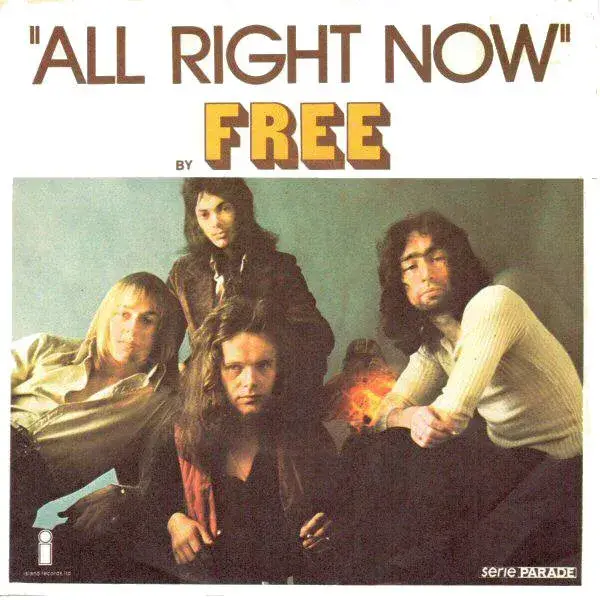
Some songs refuse to die. Nearly six decades after it first blasted out of radios across the world, "All Right Now" by Free remains one of rock's most instantly recognizable moments — a song so perfectly constructed that it sounds as fresh today as it did in 1970.
Free was a British rock band formed in London in 1968, built around four remarkably young and talented musicians — vocalist Paul Rodgers, guitarist Paul Kossoff, drummer Simon Kirke, and bassist Andy Fraser. The band had been together for two years before "All Right Now" came along, respected in rock circles but not yet a household name.
The song was born out of necessity. Frustrated by slow-burning album tracks that weren't connecting with live audiences, bassist Andy Fraser reportedly wrote the main riff and basic structure in about 15 minutes backstage before a show. Paul Rodgers added the lyrics — a simple, swaggering story of a guy hitting on a girl in the street — and just like that, one of rock's greatest anthems was born.
What makes "All Right Now" so enduring is its effortless cool. Paul Kossoff's guitar riff is one of the most recognizable in rock history — laid back, confident, and dripping with blues influence. Rodgers' vocals are raw and soulful far beyond his 20 years, and Fraser's bass holds the entire thing together with a groove that makes it impossible to stand still.
The song clocks in at just over three minutes in its single form, though the album version stretches to nearly six. Either way, it never overstays its welcome.
Released in May 1970, "All Right Now" became a massive international hit, reaching number 2 on the UK Singles Chart and breaking into the top 5 in the United States. It became the defining song of Free's career, overshadowing a catalog that many rock purists argue deserves far more attention than it gets.
Ironically, the song's enormous success was something of a double-edged sword. Free was a band of considerable depth and musicianship, but "All Right Now" followed them everywhere — both a gift and a shadow they could never quite step out from under.
Despite a string of well-regarded albums, Free never managed to replicate the commercial success of "All Right Now" on the singles chart, earning them the somewhat unfair "one hit wonder" tag in the eyes of casual listeners. The band struggled with internal tensions, Paul Kossoff's well-documented battles with drug addiction, and a series of breakups and reunions before finally dissolving in 1973.
Kossoff, whose guitar playing on "All Right Now" remains the stuff of legend, died in 1976 at just 25 years old. His loss robbed rock and roll of one of its most gifted players.
After Free disbanded, Paul Rodgers went on to massive success with Bad Company, and later filled in as lead vocalist for Queen. But "All Right Now" kept its own life going entirely independent of its creators. It has appeared in countless films, TV shows, and commercials. It remains a staple of classic rock radio worldwide. In 2004 it was inducted into the Grammy Hall of Fame.
There is something wonderfully democratic about the song's staying power. It does not require context or backstory. The moment that riff hits, everyone in the room knows exactly what it is.
Perhaps the greatest thing about "All Right Now" is what it represents — proof that sometimes a song can be bigger than the band that made it, bigger than the era it came from, and bigger than any chart position or award. It is a reminder that the best rock and roll is not complicated. It is loud, it is confident, it tells a simple story, and it makes you feel good from the first note to the last.
Free may be gone, but "All Right Now" is going absolutely nowhere.
Add comment
Comments